
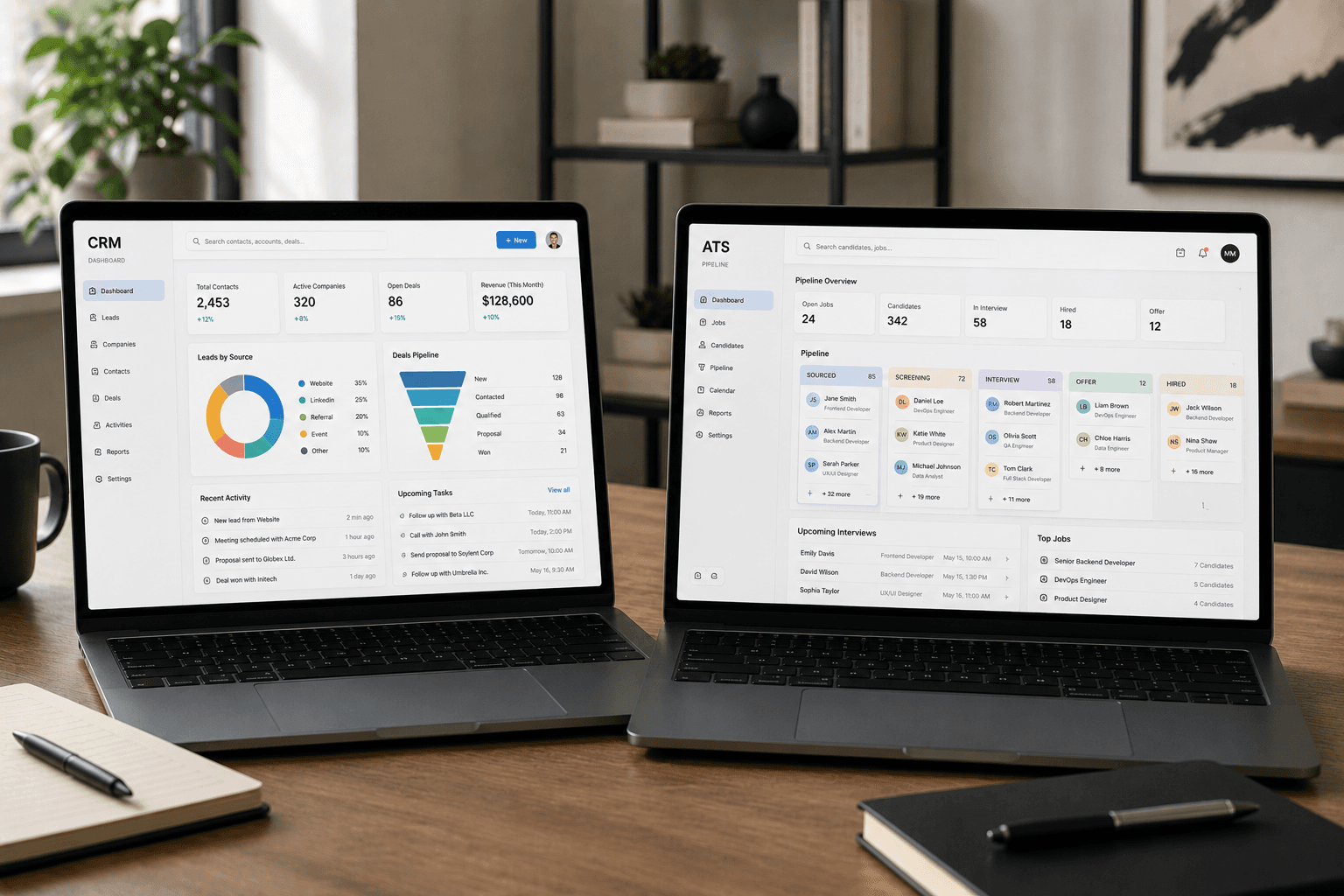
If you ask ten recruiters to explain the difference between an ATS and a CRM, you'll get ten different answers - and at least seven of them will be partially wrong.
That's not a knock on recruiters. It's a reflection of how muddled the software category has become. Vendors blur the lines deliberately. Platforms that started as applicant tracking systems added relationship management features and called themselves CRMs. Platforms that started as CRMs added pipeline management and started competing for ATS budgets. The result is a market where the terminology is genuinely confusing and the consequences of buying the wrong tool - or misusing the right one - are real.
Here's a clear breakdown of what each system actually does, where they overlap, and why the distinction matters more than most teams realize.
What an ATS Actually Does
An Applicant Tracking System is built around a specific event: someone applies for a specific job.
Everything in an ATS is organized around that application. A candidate enters the system because they responded to a job posting, and from that point forward the ATS tracks their movement through a defined hiring process - screening, interviews, assessments, offer, hired or rejected. The workflow is linear, the stages are predefined, and the outcome is binary: this person gets the job or they don't.
ATS features are designed to support that process. Job posting distribution. Application parsing and CV storage. Interview scheduling. Collaboration tools for hiring teams. Offer letter generation. Compliance and reporting.
The ATS answers one question efficiently: where is this candidate in this hiring process right now?
What it doesn't do well - and was never designed to do - is manage relationships with people who aren't currently applying for anything.
What a CRM Actually Does
A Candidate Relationship Management system is built around a different premise entirely: that the most valuable candidates are often not actively looking for a job right now.
A CRM is a long-game tool. It's where you store the senior engineer you met at a conference who wasn't interested in moving but said to reach out in a year. It's where you track the candidate who made it to the final round six months ago but lost out to an internal hire. It's where you build talent pools for roles you know are coming before they're formally open.
The relationship is the unit of value in a CRM, not the application. Someone can sit in your CRM for two years with no active application, and that's exactly as it should be - because when the right role opens, you want to reach them in a single message rather than starting from scratch.
CRM features reflect this. Contact management. Communication history. Tagging and segmentation. Automated nurture sequences. Engagement tracking. Pipeline views that aren't tied to a specific job requisition.
The CRM answers a different question: who do we know, how warm is that relationship, and who should we be talking to right now?
Where Most Teams Go Wrong
The most common mistake is using an ATS as if it were a CRM - and then wondering why the talent pool never materializes.
Here's what that looks like in practice. A recruiter interviews a strong candidate who isn't the right fit for the current role. They mark them as "rejected" or "future consideration" in the ATS, maybe leave a note, and move on. Six months later, a relevant role opens. Nobody remembers the candidate. The note is buried in a closed requisition. The recruiter starts sourcing from scratch.
The candidate, meanwhile, has accepted an offer somewhere else - or worse, has the faint memory of being ghosted after a good interview and has mentally crossed your company off the list.
This happens constantly. It's not a process failure so much as a tool mismatch. An ATS is not designed to surface past candidates proactively, maintain warm relationships over time, or support the kind of ongoing communication that turns a rejected applicant into a future hire. That's CRM territory, and using the wrong tool for it produces predictably poor results.
The opposite mistake also exists: teams that invest in a CRM but never properly configure an ATS, ending up with warm relationships they can't efficiently process when those candidates actually apply. A flooded inbox, missed follow-ups, and hiring managers asking why it's taking so long to move candidates through the process.
The Overlap - and Why Vendors Exploit It
The honest answer is that modern recruitment needs both functions, and the boundary between them is genuinely blurry in places.
When a candidate from your CRM applies for an open role, they need to transition into your ATS workflow. When a candidate is rejected at the final stage of your ATS process, they should ideally move into CRM nurturing rather than disappearing into a closed requisition. The handoff between the two systems - or the two functions within a single platform - is where most of the operational complexity lives.
Vendors have responded to this by building combined platforms that promise to do both. Some do it well. Many do it by building a mediocre ATS and calling the contacts database a CRM, or vice versa. The marketing language tends to be enthusiastic regardless of the underlying capability.
The questions worth asking when evaluating any platform that claims to cover both:
How does the system handle candidates who exist in the relationship layer but haven't applied for anything? Can you communicate with them, track engagement, and segment them without creating a fake job application to attach them to?
How does the handoff work when a nurtured candidate becomes an active applicant? Is it seamless, or does someone have to manually recreate their information in a different part of the system?
What does the reporting look like across both functions? Can you see not just time-to-hire and pipeline conversion, but also which talent pool segments are producing hires, and how long relationships are being nurtured before they convert?
If the answers are vague, the platform probably does one thing well and has bolted on the other as a feature rather than building it as a core capability.
What This Means for How You Set Up Your Recruitment Stack
If you're running a small in-house team filling a handful of roles per year, a decent ATS with basic contact management might genuinely cover everything you need. The overhead of maintaining a separate CRM isn't justified by the volume.
If you're running a recruitment agency, an internal talent acquisition function at a scaling company, or any operation where proactive sourcing and relationship building are central to how you find candidates - you need both functions working properly, whether that's in one platform or two.
The practical implication is that your database hygiene and workflow design matter as much as the software you choose. An ATS full of duplicate records and inconsistent pipeline stages will underperform regardless of how good the underlying system is. A CRM where nobody actually logs communication or updates contact status is just an expensive address book.
The technology is only as useful as the discipline around it - which is an uncomfortable truth in a market that prefers to sell software as the solution rather than the enabler.
The Short Version
An ATS manages active hiring processes. A CRM manages talent relationships over time. You need both functions. The question is whether you need them in separate tools or whether a single platform can genuinely deliver both without compromising either.
Most teams underinvest in the CRM function and then wonder why they're always sourcing from scratch. The candidates you need for next year's hardest roles are probably already in your network. The question is whether your systems - and your habits - are set up to find them when the time comes.
© 2026 Recruitment.bg — All rights reserved.