
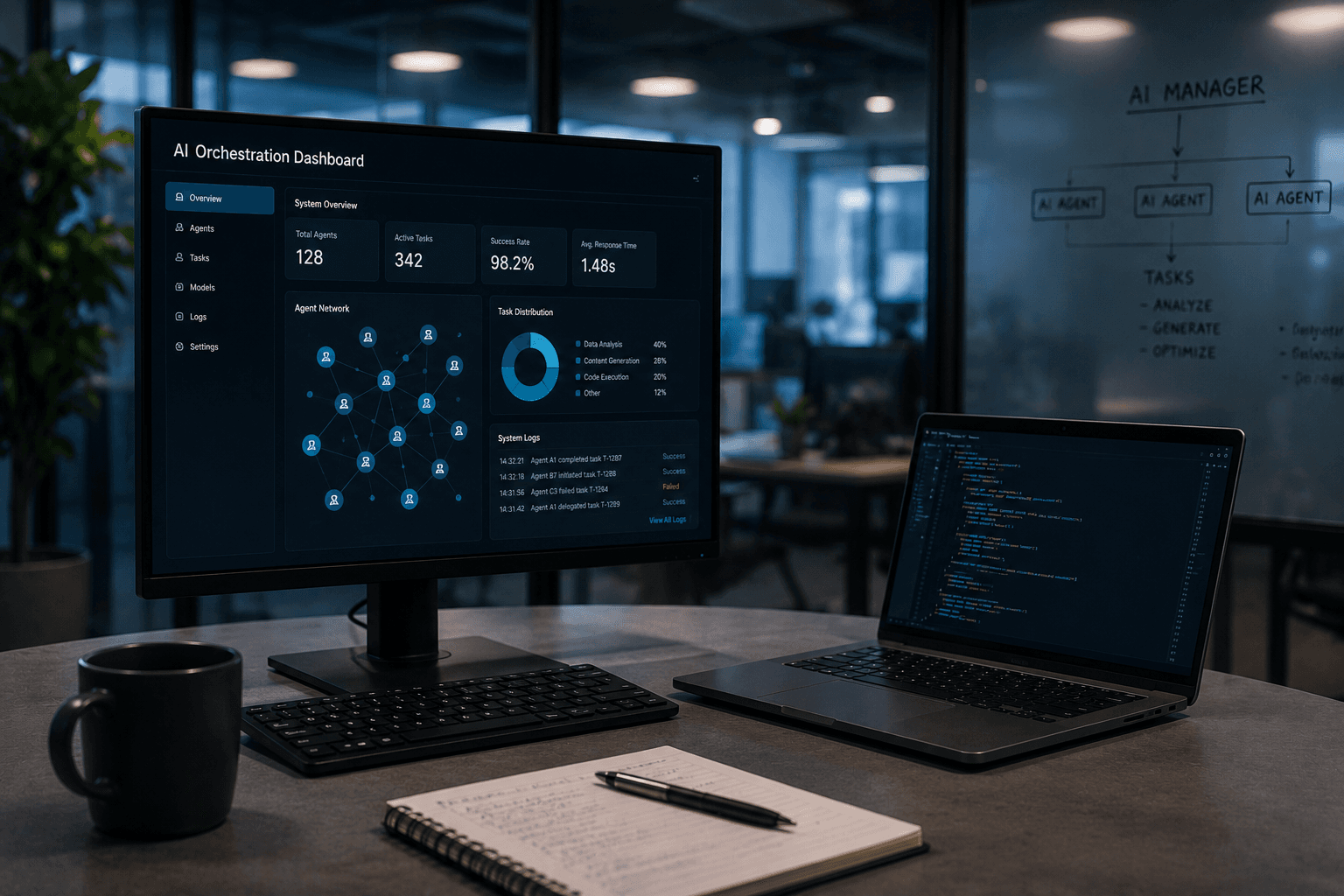
Artificial intelligence has become a standard part of modern engineering and business operations. Development teams use it to generate code, security analysts investigate alerts with AI-assisted tooling, cloud engineers automate infrastructure, and business teams rely on it to summarize meetings or analyze large datasets. In most organizations, however, AI is still viewed primarily as a productivity tool that helps individuals complete tasks more efficiently. While that perspective accurately describes the first wave of enterprise AI adoption, it no longer reflects where the technology is heading.
A growing number of enterprise platforms are moving beyond single-model interactions and adopting multi-agent architectures, where several specialized AI systems collaborate to complete complex workflows. Rather than asking one model to perform every step, these platforms assign planning, research, execution, validation, and quality assurance to separate agents, while an orchestration layer coordinates the entire process. This represents more than another automation trend—it introduces a new management layer in software systems where AI increasingly assigns work, evaluates outcomes, and determines the next course of action with limited human intervention.
AI Is Moving Beyond Individual Automation
The first generation of enterprise AI focused on improving individual productivity. Developers generated boilerplate code, analysts summarized reports, and knowledge workers automated repetitive administrative tasks without fundamentally changing how work itself was organized. AI accelerated existing processes, but humans still coordinated every step and decided how individual tasks fit together.
The next stage of AI adoption shifts attention from completing isolated tasks to orchestrating complete workflows. Instead of manually coordinating multiple prompts or switching between specialized tools, organizations are deploying systems capable of breaking down objectives into smaller tasks, assigning those tasks to the most appropriate AI agents, validating intermediate results, and deciding whether additional iterations are required before presenting a final output. From an engineering perspective, this resembles workflow orchestration or distributed systems more than traditional automation.
A typical orchestration pipeline may include:
- A planning agent that interprets the objective.
- A research agent that gathers supporting information.
- A coding or writing agent that produces the initial output.
- A validation agent that reviews quality and consistency.
- An orchestration agent that determines whether additional work is required before returning the result.
The Rise of AI Managers
Describing AI as a "digital employee" increasingly feels incomplete because many enterprise platforms now rely on AI systems whose primary responsibility is coordinating other AI systems rather than producing content themselves. Instead of solving problems directly, these orchestration layers determine which specialized models should perform each task, evaluate the quality of completed work, request revisions when necessary, and escalate uncertain decisions to human operators.
These responsibilities closely resemble those of an experienced engineering manager or technical lead. The difference is not in the nature of the decisions being made but in their speed and scale. What previously required meetings, emails, or manual coordination can now occur in milliseconds, allowing organizations to execute increasingly complex workflows with minimal human involvement.
This shift also changes where engineers provide the most value. Rather than manually driving every stage of execution, experienced developers increasingly supervise workflows, validate assumptions, and intervene only when automation reaches its limits.
Delegation Becomes an Algorithm
Delegation has always been one of management's most valuable skills because effective leaders continuously decide who should handle a task, when specialized expertise is required, and how limited resources should be allocated. AI orchestration systems perform similar decisions using measurable signals instead of organizational familiarity or personal experience.
Rather than considering personalities or team dynamics, orchestration engines evaluate factors such as historical performance, model specialization, confidence scores, execution latency, processing costs, previous outcomes, and current availability. This enables remarkable consistency across thousands of decisions that would otherwise require continuous human oversight, but it also introduces an important engineering challenge.
Unlike experienced managers, AI systems cannot always provide explanations that satisfy business stakeholders. A recommendation may be technically sound while remaining difficult to justify in operational terms, making explainability an engineering requirement rather than simply an AI research topic. As orchestration platforms become responsible for larger portions of enterprise workflows, transparency becomes essential for debugging, governance, and organizational trust.
Software Engineering May Experience the Biggest Shift
Software development already provides one of the clearest examples of AI coordinating AI. Instead of relying on a single coding assistant, organizations are beginning to experiment with development pipelines where different AI agents generate code, review pull requests, execute automated tests, perform security analysis, and validate deployment readiness before an orchestration layer decides whether additional revisions are necessary.
For senior engineers, this changes the nature of daily work rather than eliminating it. Routine implementation tasks are increasingly automated, while architectural reviews, design decisions, debugging complex edge cases, and validating AI-generated assumptions become more important. Reviewing machine-generated code at scale requires deep technical judgment because subtle design flaws, security issues, and long-term maintenance concerns remain difficult to detect automatically.
This does not reduce the importance of engineering expertise. Instead, it shifts experienced developers toward higher-leverage work where technical judgment, architectural thinking, and system design deliver greater value than writing every implementation detail manually.
AI Management Creates New Operational Risks
Much of the public discussion around AI focuses on incorrect outputs or hallucinations, but orchestration systems introduce a different category of risk. Like human managers, they can make poor decisions even when every individual contributor—or AI model—is technically capable of performing its assigned work.
Consider an orchestration platform optimized primarily for execution speed. It may consistently select the fastest available models while overlooking quality issues that emerge only after deployment. Another platform optimized aggressively for cost reduction may avoid using specialized models entirely, even when they would produce substantially better results. Neither system is malfunctioning; each is faithfully optimizing the objective it was given.
This highlights an important engineering lesson that extends beyond artificial intelligence. Poor objectives often produce poor outcomes, regardless of how well the underlying system performs. As AI becomes increasingly effective at optimization, weaknesses in organizational priorities become more visible rather than less.
Governance Will Become a Competitive Advantage
Early AI governance focused primarily on privacy, compliance, and security. Those concerns remain essential, but organizations deploying multi-agent systems must also address operational governance, ensuring they can understand how decisions were made throughout increasingly complex AI workflows.
Engineering teams will need visibility into questions such as which agent selected a particular model, why alternative approaches were rejected, where human approval was required, how outputs changed during execution, and how each contributing agent influenced the final result. These requirements resemble distributed systems observability and audit logging far more than traditional software documentation.
Organizations that invest early in transparency, monitoring, and traceability will be better equipped to troubleshoot failures, satisfy regulatory requirements, and improve orchestration strategies over time.
Human Managers Are Not Going Away
Predictions that AI will eliminate management roles often underestimate what experienced leaders actually contribute. Assigning work represents only a small portion of management responsibilities, while defining priorities, resolving ambiguity, aligning stakeholders, developing people, and remaining accountable for outcomes continue to require human judgment.
AI can coordinate execution exceptionally well, but accountability cannot be delegated to software. As orchestration platforms become more capable, managers and technical leaders are likely to spend less time distributing work and more time designing workflows, defining success metrics, and deciding where human oversight creates the greatest value.
The result is not the disappearance of leadership but a shift toward higher-level decision making, where strategy and judgment become increasingly important as routine coordination becomes automated.
The Next Management Framework Is Still Being Written
Every major platform shift has eventually transformed the way engineering organizations operate. Cloud computing redefined infrastructure management, DevOps reshaped software delivery, and platform engineering changed how internal developer tooling is built and maintained. Multi-agent AI appears to be following the same pattern by changing how knowledge work is coordinated rather than simply how individual tasks are completed.
Although the technology is advancing rapidly, many operational practices remain immature. Organizations are still developing approaches to governance, accountability, workflow design, performance measurement, and human oversight that match the capabilities of increasingly autonomous AI systems. For experienced engineers, this creates an opportunity to influence how these systems are designed before today's experimental patterns become tomorrow's industry standards.
The engineers who understand both AI capabilities and the operational challenges of orchestrating complex software systems will be well positioned as multi-agent architectures become a more common part of enterprise technology. Staying informed about these changes today will make it easier to evaluate, adopt, and improve them as they move into production environments.
© 2026 Recruitment.bg — All rights reserved.